Cyprus is a compact island with a growing appetite for two-wheeled mobility. From coastal promenades to inland mountain tracks, the island’s topography and climate make cycling a practical daily transport option and an attractive tourism product. This article examines how cycling Cyprus infrastructure is evolving, how bike rentals Cyprus serve residents and visitors, and what planners and riders should expect in the near future.
The link between property, mobility, and lifestyle is becoming clearer: for people considering relocation or investment on the island, proximity to amenities such as secure bicycle storage and connected bicycle paths can be a selling point. See Cyprus residential property for examples of how residential developments integrate active travel into masterplans and amenities. This connection matters to developers and to anyone who values convenient, healthy transport options.
Well-designed cycling infrastructure transforms streets into accessible arteries for everyday life and tourism alike.
The existing framework: what counts as cycling infrastructure in Cyprus
Cycling infrastructure is more than painted lanes: it includes physical bicycle paths Cyprus-wide, protected lanes, shared-use promenades, parking and docking stations, signage, maintenance facilities, and integration with public transport. On Cyprus, this infrastructure appears unevenly: coastal cities such as Limassol and Larnaca have invested in promenades and multi-use paths, while many suburbs and rural roads remain dominated by motorised traffic. The technical definition used by planners—separated lanes, advisory lanes, or shared streets—determines safety and usability for different rider types.
Planners and engineers refer to three broad categories of infrastructure: on-road protected lanes, off-road bicycle paths Cyprus-wide, and mixed-use spaces where cyclists share pavement with pedestrians. Each category requires distinct design standards. Off-road bicycle paths tend to be found along coastal strips and riverbeds, where there is room to build physically separated facilities. On-road facilities appear more in retrofitted urban corridors, where kerb extensions, bollards, and reallocated carriageway space can provide protection.
Technical standards influence long-term maintenance commitments. Paving composition, drainage, and signage determine how sustainable a path will be under heavy sun, seasonal rain, and occasional floods that affect parts of the island. Municipal maintenance regimes are therefore as important as initial design: a well-built lane that is not swept, repainted, or repaired will degrade quickly into a risky route.
Infrastructure is only as good as its maintenance plan and the clarity of its design standards.
Urban cycling: city-scale networks and bike sharing systems
Cities present the greatest opportunity for modal shift from cars to bikes because of short trip distances and dense origins/destinations. Cycling routes Cyprus cities are being planned to link transit hubs, university campuses, and waterfronts. In Nicosia, initiatives focus on improving connectivity across radial routes; in Limassol and Larnaca, emphasis has been on continuous coastal paths to support commuting and leisure cycling. Urban planners are now balancing the need for short, direct routes with the political and technical challenge of reallocating road space.
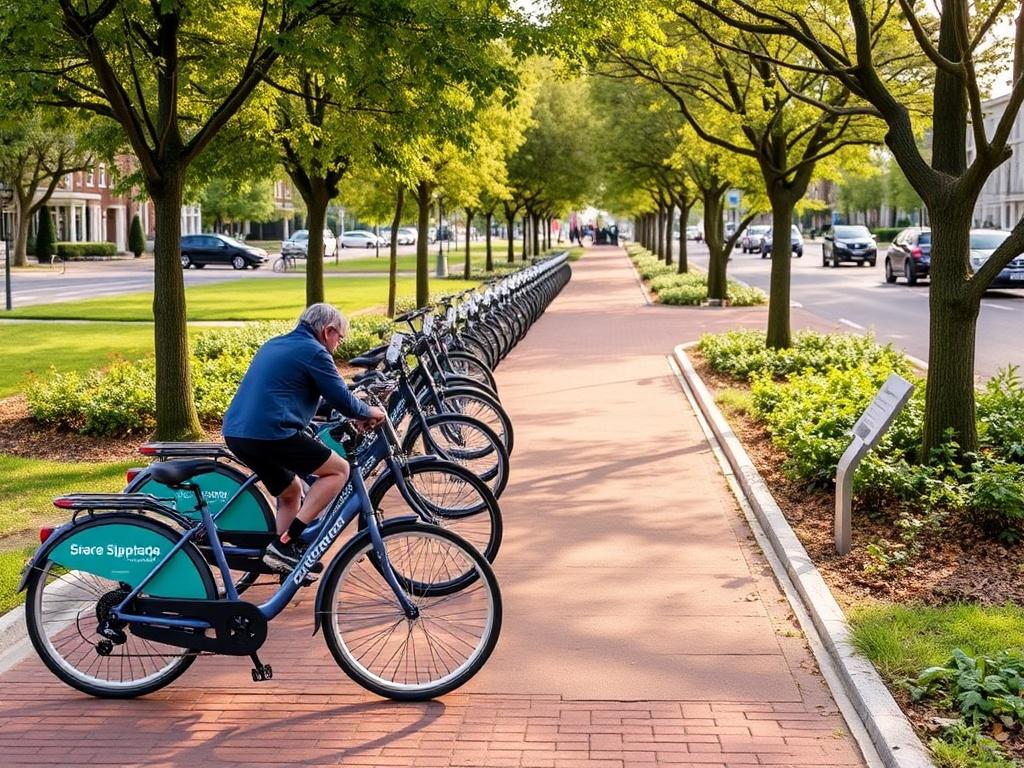
Bike sharing Cyprus projects have emerged as part of this urban push. Docked and dockless systems provide flexible mobility and lower barriers to entry for occasional users. Integration with city transport cards and mobile apps has made bike sharing more convenient, but long-term success requires station density, good parking and charging for e-bikes, and enforcement against clutter. Operational models vary: municipality-managed systems operate differently from private providers, and hybrid contracts with performance metrics are becoming the norm.
City-scale bike sharing can catalyse everyday cycling, but system design and integration will determine uptake.
Urban design touches every street: traffic calming, intersection upgrades, and signal timing adjustments can make the difference between a comfortable ride and regular conflict with vehicles. Effective urban networks include continuous corridors with minimal stops, secure parking at key destinations, and safe intersections. For many people, perceived safety is the primary determinant of whether they will switch from car trips to bicycle trips.
Design elements that influence city cycling
Key elements include minimum lane widths, buffer zones, kerb protection, and thoughtful intersection treatments. Cycle track widths should accommodate overtaking and cargo bikes in commercial corridors; buffers help reduce dooring risks from parked cars. Intersection safety devices—such as advance stop boxes, separate signal phases, and curb extensions—reduce collision risk and increase predictability for all road users.
Installation of wayfinding signs and maps also supports ridership, especially for visitors who depend on clear route information. Many cities use consistent pictograms and coloured routes that link to online maps and mobile navigation, which helps unify the experience across neighbourhoods.
Bike rentals in Cyprus: options, logistics, and expectations
For visitors and locals who do not own a bike, bike rentals Cyprus companies provide a practical gateway to cycling across the island. Rental outlets range from small local shops and hotel desks to larger operators offering guided tours and corporate services. Typical fleets include hybrid and trekking bikes, mountain bikes for off-road trails, road bikes for longer-distance routes, and an increasing number of e-bikes to help riders handle hills and wind.
Rental business models differ: hourly or daily hire for casual tourists, long-term hire for expatriates and students, and guided services that bundle equipment, route planning, and support. Many rental companies now allow online booking and provide helmets, locks, and lights; high-demand seasons require pre-booking to secure specific bike types. Prices vary by bike type and level of service, and some operators offer delivery and pick-up for groups.
Choosing the right rental type—mechanical reliability, appropriate gearing, and local route knowledge—makes or breaks the riding experience.
Operational quality varies significantly. Reputable providers maintain a documented maintenance schedule, perform regular safety checks, and use sturdy locks. If you expect to ride longer distances, inquire about spare tubes, pump access, and emergency contacts. Some operators partner with hotels to provide secure overnight storage and minor tune-ups for returning customers.
| Provider Type | Typical Fleet | Common Add-ons |
|---|---|---|
| Local Rental Shop | Hybrid, mountain, helmets | Maps, basic repair kit, light delivery |
| Guided Operator | Road, e-bikes, group support vehicles | Guides, refreshments, transport |
| Hotel Desk | City/hybrid bikes | Short-term hire, storage |
The table above summarises the broad categories of rental services rather than listing specific firms. When choosing among options, check recent reviews, ask about insurance coverage, and, if applicable, confirm whether helmets are mandatory or optional for rentals.
Signature routes: coastal, mountain, and cultural rides
Cyprus offers a diversity of topography that suits a wide range of cycling experiences. Coastal rides provide flat, scenic kilometres with frequent stops for coffee and sea views; inland routes climb into the Troodos Mountains for steep grades and panoramic descents; and archaeological corridors link ancient sites with quiet roads that are ideal for exploratory rides. These signature routes attract different rider profiles: families and leisure tourists on the coast, fit cyclists and mountain bikers inland, and cultural tourists on hybrid bikes connecting villages and heritage sites.
Well-chosen routes showcase the island’s landscape and cultural richness while offering varied difficulty and infrastructure needs.
A short list of illustrative routes highlights the island’s variety without repeating details from earlier sections:
- Limassol Promenade to Lady’s Mile: continuous coastal path, ideal for families and short city escapes.
- Paphos Archaeological Loop: interspersed paved roads and short off-road segments linking heritage sites.
- Troodos Ascent: a challenging climb with steep gradients, technical descents, and mountain scenery.
- Akamas Peninsula Coastal Trail: mixed surfaces and protected natural areas suitable for experienced riders.
- Nicosia Radial Connectors: urban corridors designed to link residential neighbourhoods to transit.
Each route requires a different support profile: coastal rides need signage and drinking water stations; mountain routes need robust trail maintenance and clear markers; urban connectors require intersection safety and continuity to be viable as commuter routes.
Safety, regulation, and rider responsibility
Rules and regulations for cycling in Cyprus incorporate national traffic law, municipal bylaws, and sometimes local signage that clarifies permitted uses of paths. Helmets are not universally mandated for adults in all circumstances, but wearing a helmet is strongly advised, particularly on high-speed or technical descents. Night riding requires lights and reflective clothing. Cyclists must follow the same road rules as motor vehicles where lanes are shared, including respecting traffic signals and yielding when required.
Enforcement varies by jurisdiction; some municipalities conduct targeted safety campaigns and occasional fines for unsafe behaviour by either drivers or cyclists. Education efforts focus on safe passing distances, dooring prevention, and the importance of signalling intentions at intersections. For rental providers, liability waivers are common, but understanding local regulations and carrying personal insurance are prudent steps for regular riders.
Law and practice are evolving: personal responsibility and clear local rules together make cycling safer for everyone.
Best practices for riders include pre-ride route planning, carrying a charged phone with local emergency numbers, and using durable locks in urban environments. Group riding etiquette—single file on narrow roads, clear verbal cues, and predictable manoeuvres—reduces conflict and improves safety for everyone on the route.
Policy, funding, and institutional drivers
Development of cycling Cyprus infrastructure is driven by municipal ambition, national transport policy, and external funding sources such as European Union grants. Municipalities compete for funding to build promenades and greenways, and national policy increasingly recognises cycling as a tool to reduce congestion, improve public health, and lower carbon emissions. Funding models include capital grants for construction and recurrent budgets for maintenance, which are equally important but often less politically visible.
Institutional capacity matters: municipalities with dedicated sustainable transport teams are more likely to deliver and maintain high-quality bicycle paths and to coordinate with utilities and urban designers. Cross-departmental working groups that combine transport, environment, tourism, and urban planning yield more holistic outcomes. Performance metrics—such as modal share targets, kilometres of protected lanes, and ridership figures—help justify continued investment when reported transparently.
Long-term success depends not only on capital expenditure but on institutional commitment to maintenance and integrated planning.
Policy tools that have proven effective elsewhere—congestion management, parking reform, and incentives for employers to support cycling—are starting to appear in pilot programs. These measures are politically sensitive but can be implemented gradually to manage impacts while growing cycling uptake.
Operational challenges: maintenance, heat, and seasonal factors
Cyprus’ climate presents specific maintenance challenges for bicycle paths. High summer temperatures can cause asphalt to soften, while sudden storms may cause localised flooding and debris on coastal promenades. Drainage design is therefore a crucial part of long-term durability. Municipalities need cyclical maintenance plans that include regular sweeping, resurfacing where necessary, and vegetation control to keep routes clear and safe.
E-bikes require charging infrastructure and secure parking. Operators of bike sharing Cyprus systems must budget for battery swapping and centralised charging hubs, particularly for dockless fleets that tend to scatter batteries across the urban area. Seasonal tourism peaks also create demand surges; rental fleets need to scale capacity without compromising maintenance standards during these periods.
Durable materials and proactive maintenance plans are essential to keep infrastructure usable year-round.
Preventive measures—such as using heat-resistant pavements in high-sun zones and placing drainage openings away from cycle lines—reduce the frequency of disruptive repairs. Local governments can contract with specialised maintenance teams to respond to incidents quickly and maintain consistent service levels.
Tourism, economics, and community benefits
Cycling tourism is an economic opportunity that extends the tourism season and disperses visitors beyond congested summer hotspots. Bike rentals Cyprus businesses benefit from this trend by offering guided experiences and multi-day itineraries that combine accommodation with route planning. Municipalities that create connected networks make it easier for hotels and guesthouses to market themselves to cycling tourists, who typically spend on equipment services, food, and local attractions.
Local communities gain from reduced traffic noise, improved pedestrian environments, and new social spaces created by promenades and cycleways. Small businesses along popular routes—cafés, repair shops, and local tour guides—can tap into an incremental customer base. Community engagement in route design, such as participatory mapping and public consultations, tends to produce facilities that are better used and better cared for.
Investing in cycling infrastructure has measurable local economic benefits when integrated with tourism and business strategies.
However, unmanaged growth can lead to conflicts between users and to displacement of existing activities. Thoughtful zoning, time-of-day rules, and design for multi-functionality (e.g., market days) help balance competing uses and retain community support.
Technical design standards: materials, geometry, and signage
Good design is grounded in measurable standards. Cycle track widths depend on expected volumes and type of cyclists: 1.5–2.5 metres for single-direction tracks is typical for many urban contexts, with additional width for two-way tracks. Horizontal and vertical clearances ensure that larger cargo bikes and tandems can pass safely. Materials selection—fine-graded asphalt, porous paving where appropriate, and non-slip surfaces on steep descents—matters for both safety and longevity.
Signage and pavement marking provide clear information for route orientation and regulatory messages. Consistent symbol language—directional arrows, route numbers, and distance markers—helps both residents and tourists. Lighting design must consider constant illumination on key commuter corridors and motion-activated solutions on less-used trails to balance safety and energy use.
Standards translate design intent into repeatable, safe infrastructure that riders can trust.
Intersection geometry should prioritise predictability: curb radii, signal phasing, and micro-design of crossings determine how conflicts are resolved. Designers often use separated signal phases for left-turns and right-turns to reduce interactions between fast-moving cyclists and turning motor vehicles. Properly configured crossings with raised tables or zebra markings slow vehicular traffic at conflict points.
Materials and durability considerations
Selecting the right pavement materials is context-sensitive. Coastal areas require materials that resist salt corrosion and abrasive sand; inland mountain tracks need frost-resistant mixes where temperature variability is greater. Joints and expansion features are important where long straight paths might otherwise buckle in hot weather. Maintenance-friendly designs use modular elements that can be replaced in sections without disrupting long stretches of route.
Integrating cycling with land use and property development
Developers and planners increasingly see cycling as a value-adding amenity. New residential projects marketed to health-conscious buyers frequently include secure bike storage, maintenance rooms, and easy access to bicycle paths. Integrating cycling facilities with property developments helps increase active travel modal share by making cycling the most convenient option for short trips, errands, and commuting.
Local planning codes can encourage or mandate cycling provisions. Requirements might include a minimum number of cycle parking spaces per dwelling, electric charging points for e-bikes, and covered storage to protect expensive equipment from sun and theft. Developer contributions to off-site cycle paths can also be negotiated to expand the public network while addressing the immediate demand generated by new housing.
When cycling is embedded in land-use planning, it becomes a structural part of daily life rather than an afterthought.
Investment in nearby amenities—in particular, shops, schools, and public transport interchanges—magnifies the benefit of cycling infrastructure. Properties that advertise proximity to connected bicycle paths and secure parking often command a market premium among buyers who prioritise active transport and lower car dependence.
Community engagement and behavioural change
Infrastructure alone does not guarantee cycling uptake. Behavioural change campaigns—public education, bike-to-work days, and school cycling programs—play a critical role in shifting culture. Communities that run bike repair clinics, led rides, and skills training see faster increases in ridership and more diverse user groups. Programs aimed at children and parents are especially effective because they create new generations of confident cyclists.
Engagement must be inclusive: outreach should target older adults, women, and people with disabilities to understand and remove barriers. Inclusive design may require lower kerb heights, ramps, and consideration for adaptive cycles. Active community groups can also act as watchdogs who report maintenance issues and help co-manage certain facilities under formal agreements with municipalities.
Behavioural programs amplify infrastructure investments, turning paths and lanes into lived spaces used daily.
Long-term cultural change is incremental. Combining visible short-term wins—temporary pop-up lanes or street closures—with medium-term commitments to build protected infrastructure helps sustain political and public support.
Where cycling in Cyprus goes next
The future of cycling in Cyprus depends on coherence across design, operations, and policy. Investment in continuous networks that prioritise safety and convenience will unlock much larger modal shifts than isolated projects. Mature bike sharing Cyprus models integrated with public transport, combined with consistent maintenance, will make cycling a credible daily choice for many more residents. At the same time, demand-driven services such as bike rentals Cyprus operators will continue to boost tourism and local economies.
Planners should pursue a phased approach: quick-build protected lanes to demonstrate benefits, followed by permanent infrastructure backed by robust maintenance budgets and institutional responsibilities. Monitoring and evaluation frameworks—measuring ridership, safety outcomes, and economic impacts—will provide evidence to secure long-term commitments and allow adaptive management.
Investment decisions will have to balance competing priorities on a small island with limited budgets. Nevertheless, opportunities exist: EU funding streams, private-public partnerships, and synergies with tourism and property sectors can be marshalled to expand and maintain networks. The objective is to design an interlinked system that serves daily commuters, leisure riders, and visitors without sacrificing safety or accessibility.
Strategic, evidence-led investments will determine whether the island’s cycling future is incremental or transformative.
Ultimately, cycling infrastructure that is well-designed, properly maintained, and integrated with land use will change how people live, work, and travel in Cyprus. For decision-makers, the task is to translate good intentions into predictable, measurable, and sustained outcomes that benefit residents and visitors alike.
Frequently Asked Questions
1. What are the most common types of bike rentals in Cyprus and how do prices typically vary?
Answer: The most common rentals are hybrid/trekking bikes, mountain bikes for trails, road bikes for longer distances, and e-bikes. Prices vary by type—standard hybrids are cheaper (daily rates), while road bikes and e-bikes cost more; guided tours and multi-day rentals increase total cost due to added services.
2. Are bicycle paths in Cyprus continuous enough for commuters to use them daily in cities like Limassol and Nicosia?
Answer: Some corridors are continuous—especially coastal promenades in Limassol and Larnaca—while Nicosia has radial connectors under development. Commuters often combine protected segments with low-traffic side streets; full continuous networks remain a work in progress.
3. How does bike sharing Cyprus typically manage e-bike charging and redistribution?
Answer: Operators use centralized charging hubs, battery-swapping protocols, or mobile crews to collect low-charge units for recharging. Redistribution is done by staff vehicles or in-app incentives for users to move bikes to under-served stations.
4. What safety equipment is recommended and are helmets legally required?
Answer: Recommended equipment includes a properly-fitted helmet, front and rear lights, reflective clothing for night riding, and a repair kit. Helmet laws vary by age and context; even where not mandatory for adults, helmets are strongly advised for safety.
5. Can tourists ride e-bikes across mountain routes like Troodos safely, and are batteries supported on those trails?
Answer: Experienced riders can use e-bikes on many mountain ascents, but battery range, steep gradients, and trail technicality must be considered. For remote routes, plan for limited charging; guided operators often provide vehicles for support or arrange charge points.
6. How can property developers integrate cycling to add value to residential projects?
Answer: Developers can include secure bike parking, repair stations, e-bike charging, and direct access to nearby bicycle paths. Providing communal maintenance tools and promoting proximity to routes increases property appeal to active buyers.
7. Where can I find official maps of cycling routes and bicycle paths Cyprus-wide?
Answer: Official maps are available from municipal transport departments and national tourism agencies; many routes are also listed on local tourism websites and through bike rental operators who keep up-to-date route guides and printable maps.